
Built for mortgage. Live in days. Onshore, audit-safe AI that plugs into your LOS.
For decades, mortgage operations teams have been trapped in a painful cycle of document chaos, manual review, long cycle times, and rising costs. Many lenders still believe mortgage automation must be complex, custom-built, or human-assisted. But that assumption leads to brittle, slow, and high-risk workflows. The real blockers include:
- Disconnected tools → Constant rekeying, LOS mismatches
- Manual checklists → Delays, errors, missed SLAs
- Offshore data review → Compliance risk, slow turnaround
- “AI” that solves one task → Still need people to connect the dots
TRUE’s Mortgage Operating System (MOS) replaces this complexity with intelligent background workers — Mortgage AI agents trained specifically for mortgage operations. All pre-configured. All interoperable. All designed to deliver immediate impact without manual workarounds or custom development.
What Is Mortgage Process Automation, and Why Does It Matter Now?
Mortgage process automation refers to the use of intelligent technology to handle the end-to-end mortgage workflow, moving beyond manual data entry, disconnected tools, and piecemeal solutions.
Unlike early automation efforts, which focused on simple, rule-based tasks or required custom development, modern mortgage automation leverages interoperable, pre-configured AI agents designed specifically for lending. These systems can parse documents, apply lender-specific rules, and deliver structured, audit-ready outputs, without the need for offshore review or complex IT projects.
Automation is now a prerequisite for meeting borrower expectations, managing compliance risk, and scaling operations in a digital-first mortgage market. Lenders who rely on manual, fragmented workflows risk falling behind as automation becomes the new industry standard.
It’s important to recognize what mortgage process automation is not:
- It is not limited to simple data entry or document scanning.
- It does not require custom coding or months of IT lift.
- It is not about replacing people, but about enabling existing mortgage ops teams to focus on higher-value work.
In short, mortgage process automation is the backbone of modern lending: empowering organizations to deliver faster, safer, and more consistent borrower experiences while laying the groundwork for future innovation.
How TRUE Automation Works — Behind the Scenes
TRUE’s background AI automates the full document-to-decision journey. The Result: time per loan drops from ~60 minutes to 5–10 minutes.
Step 1: Borrower docs uploaded via LOS, portal, or APIs

Step 2: TRUE parses, classifies, and applies lender-specific rules

Step 3: System generates structured, audit-safe outputs (ready for underwriting or QC), routed into Encompass and final results are ready for review

Implementation Strategies and Best Practices for Mortgage Process Automation
Successfully adopting mortgage process automation is about laying the groundwork for a smooth rollout and long-term success. Here’s a proven approach to ensure your automation initiative delivers maximum value to your mortgage operations.
1. Map and Prioritize Your Processes
- Begin by documenting your current mortgage workflows, from borrower document intake to underwriting and post-close review.
- Identify bottlenecks, manual handoffs, and high-error areas. Prioritize these for initial automation to maximize impact.
2. Align Stakeholders and Build the Right Team
- Engage leaders from operations, IT, compliance, and front-line teams early in the process.
- Assign clear roles and responsibilities using a RACI (Responsible, Accountable, Consulted, Informed) matrix to prevent confusion and ensure accountability through each phase.
3. Ensure Data Readiness and Integration
- Assess the quality, completeness, and accessibility of your mortgage data.
- Plan for seamless integration with your LOS, POS, and other core systems to prevent data silos and manual rekeying.
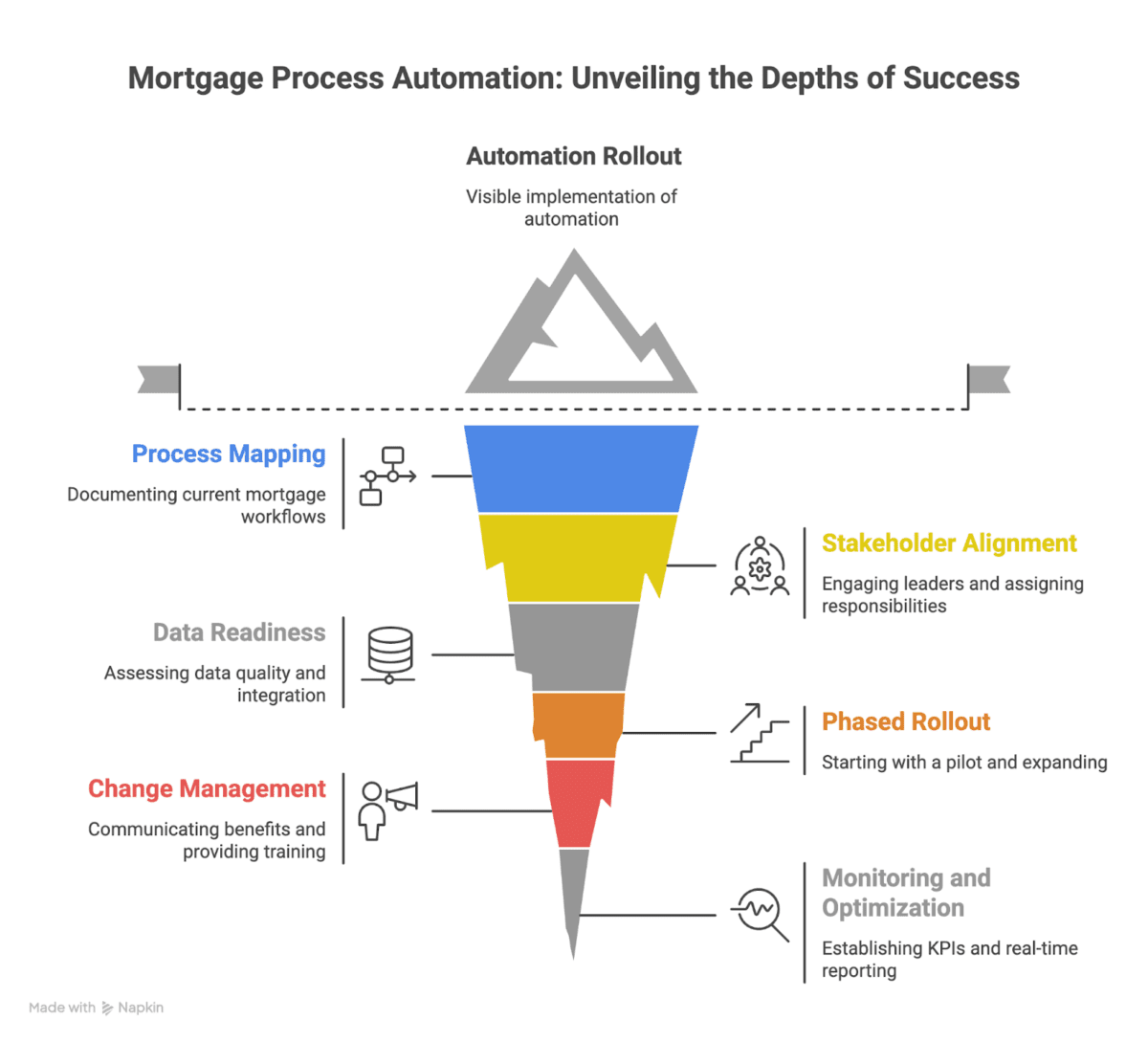
4. Roll Out Automation in Phases
- Start with a pilot on a high-impact workflow (e.g., income verification or loan setup).
- Use feedback from pilot users to refine processes before expanding automation to additional workflows.
5. Invest in Change Management and Training
- Communicate the “why” behind automation to all staff, emphasizing how it reduces busywork and elevates their roles.
- Offer hands-on training and designate automation champions to support adoption.
- Create feedback channels for continuous improvement.
6. Monitor, Measure, and Optimize
- Establish KPIs such as cycle time reduction, error rates, and audit exceptions.
- Use real-time monitoring and reporting to quickly identify issues and opportunities for optimization.
- Schedule regular reviews to assess progress and iterate on your automation strategy.
By following these best practices, lenders can minimize disruption and ensure their automation investment delivers lasting operational and competitive advantages.
What TRUE Replaces
| Pain Point | Operational Impact |
| Inconsistent Borrower Docs | Delays and Rework |
| Manual Income Verification | Higher Cost Per Loan |
| Too Many Systems | LOS Fatigue and Error Risk |
| Compliance Friction | Internal Delays and Audit Anxiety |
TRUE isn’t just faster, it’s smarter. The platform eliminates busywork, reduces risk, and accelerates loan readiness.
The Path Forward
TRUE is building the only end-to-end mortgage automation platform for lenders — no dev lift, no vendor sprawl, and no offshore risk. TRUE’s MOS platform is:
- Pre-built for loan setup, income, post-close
- Integrated with Encompass, POS, Candor
- 95%+ accuracy, 0 offshore review
- Live in < 60 days
Modern lending demands more than tech — it demands operational intelligence.
Want to See It in Action?
We’re giving early access to teams looking to reduce manual workflows and cost in their 2025 loan pipeline. Book your 15-min walkthrough with one of TRUE’s data experts.