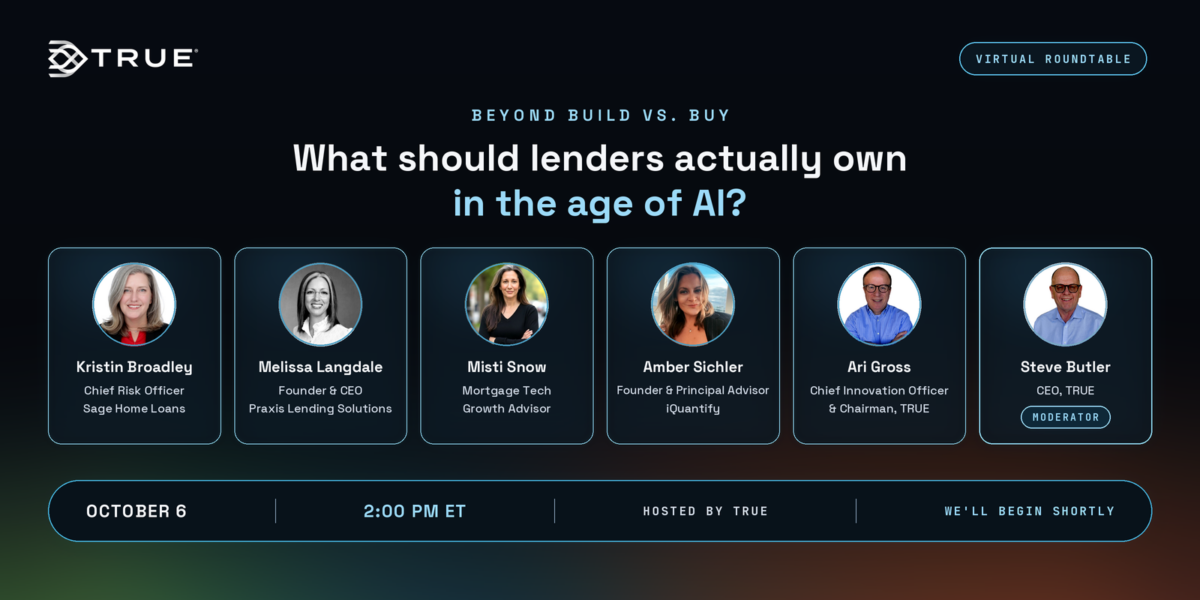
Watch the recording of our executive roundtable on what lenders should build, buy, and rethink altogether, as mortgage AI changes the mortgage operating model.
AI has made it easier than ever to build technology. That doesn’t mean it has made technology easier to own.
That distinction became one of the central themes of TRUE’s recent Build vs. Buy in the Age of AI roundtable, featuring Melissa Langdale, Misti Snow, Kristin Broadley, Amber Sichler, Ari Gross, and moderated by TRUE CEO Steve Butler.
What started as a discussion about whether lenders should build or buy technology quickly became a much broader conversation about what lenders should actually own, where AI creates real competitive advantage, and what has to change operationally before AI delivers meaningful ROI. Here are some of the biggest takeaways.
Building is the wedding. Owning is the marriage.
Melissa Langdale, Founder, CEO at Praxis Lending Solutions, opened with an analogy that framed much of the discussion:
“Building is like the wedding day. Owning is like a marriage.”
AI-assisted development and “vibe coding” may make it dramatically easier to prototype AI technology you’re seeing. But getting something built is only the beginning.
You have to think about guidelines change, regulations change, products change, workflows change, models need monitoring, systems need maintenance, and someone has to remain accountable for all of it.
That means the Build vs. Buy calculation can’t stop at “How much will it cost us to build this?” Lenders also have to ask: What will it cost us to own this three years from now?
Ari Gross, Chairman, Founder and Chief Innovation Officer at TRUE, reinforced that distinction from an engineering perspective. AI can accelerate initial development, but production software still has to be modular, interoperable, testable, maintainable and owned by someone when something goes wrong.
The prototype may be getting cheaper, but the enterprise platform isn’t necessarily following the same curve.
A successful AI task doesn’t necessarily create ROI
One of the most important discussions came from Amber Sichler, Founder and Principle Advisor at iQuantify.
Mortgage has had technology capable of calculating income for years. Yet in many workflows, loan officers, processors, underwriters and even post-close teams continue to recalculate or verify that income. As Amber put it:
“The technology did the task, but the work didn’t ever come out of the process.”
Lenders have to recognize that distinction. Automating a task is not the same as removing the work.
Misti Snow, Mortgage Tech Growth Advisor at Gritt, pushed the idea further. If technology reads a paystub accurately but someone still compares it with the W-2, determines whether a variance matters, updates the LOS, clears a condition and routes the loan, the lender may have created a smarter work queue—not true automation. Her alternative was a much bigger operating-model shift:
“The real opportunity is for the workflow to own the loan.”
AI ROI therefore isn’t simply a technology implementation problem. It requires lenders to rethink who, or what, owns the work after automation is introduced.
“We need AI” is not a business requirement.
Kristin Broadley, Chief Risk Officer at Sage Home Loans, challenged another common starting point for AI investment.
Organizations can continue adding new technology while leaving the underlying process largely untouched. But when that happens, ROI gets trapped inside an operating model designed for an earlier generation of technology. Her point was simple:
“We need AI. That’s not a business requirement.”
You need to start with the friction, then quantify it, then understand what is actually constraining the business, and finally determine whether technology is the appropriate way to remove that constraint.
That also changes how lenders should define differentiation. If something doesn’t materially change speed, pull-through, cost or customer experience, Kristin argued, it may be a preference or standard capability—not a true competitive differentiator worth building internally.
Buying the technology doesn’t outsource responsibility.
The panel also tackled an increasingly important issue everyone is talking about right now: governance.
Whether an AI capability is built internally or purchased from a vendor, the lender remains responsible for what happens inside its lending process. Or, as Kristin put it:
“The vendor built it. That is not a control framework.”
And the closer mortgage AI gets to eligibility, pricing, underwriting or other consequential decisions, the stronger the governance requirements become. That includes being able to reconstruct what the AI saw, which rules and models were used, what version was operating, what the system produced, and whether someone accepted or overrode the result.
For lenders evaluating Build vs. Buy, governance therefore isn’t separate from the economics. It’s part of the cost of ownership.
Before asking Build or Buy, ask whether the work should exist at all.
Near the end of the discussion, Melissa introduced perhaps the most fundamental question of the hour:
“Does this work still need to be done?”
Mortgage workflows still contain processes, handoffs and redundant reviews designed for an era when people had to move paper and manually stare-and-compare information.
AI creates an opportunity to do more than just automate old processes, it creates an opportunity to question them.
- Does this task need to happen?
- Does a human need to perform it?
- Does technology need to perform it?
- Or can the workflow itself be redesigned so the work disappears?
Watch the full conversation
The question facing lenders isn’t simply whether mortgage AI makes something possible to build. It’s whether owning it creates competitive advantage, whether the organization can operationalize and govern it, and whether it actually changes the economics of the business.
Watch the full roundtable to hear Melissa Langdale, Misti Snow, Kristin Broadley, Amber Sichler, Ari Gross and Steve Butler explore those questions, and where they believe lenders should draw the line.
Want to go deeper into topics and details around building vs buying mortgage AI?
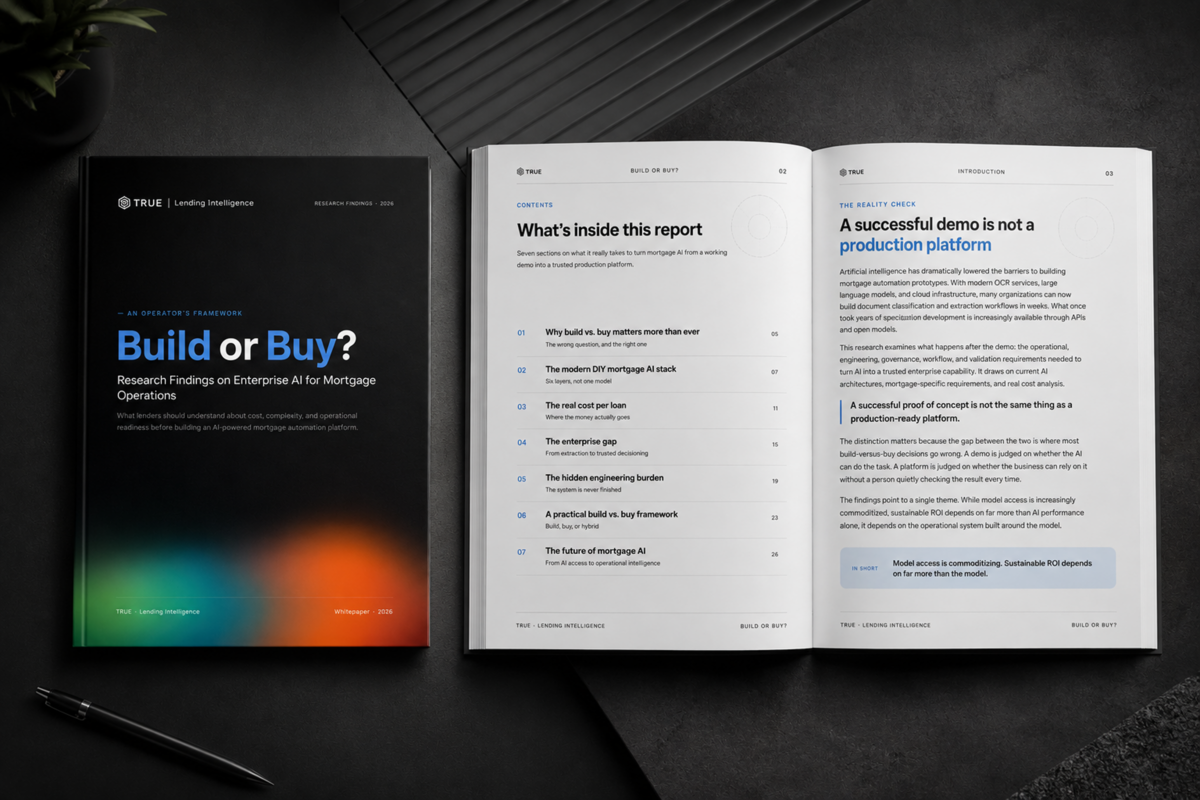
Download TRUE’s Build or Buy? Research Findings on Enterprise AI for Mortgage Operations.