
Building AI has never been easier. Building enterprise AI that works inside a mortgage operation is another story.
Across mortgage, the build vs buy conversation is changing quickly. Leaders are experimenting with AI internally, vendors are adding AI to nearly every part of the lending stack, and agentic AI capabilities are pushing automation deeper into workflows. But getting a prototype to work is only the beginning.
The real decision starts with what comes next: integration, data quality, engineering resources, adoption, monitoring, governance, model changes, vendor dependencies.
Should we build it and what are we actually committing to if we do?
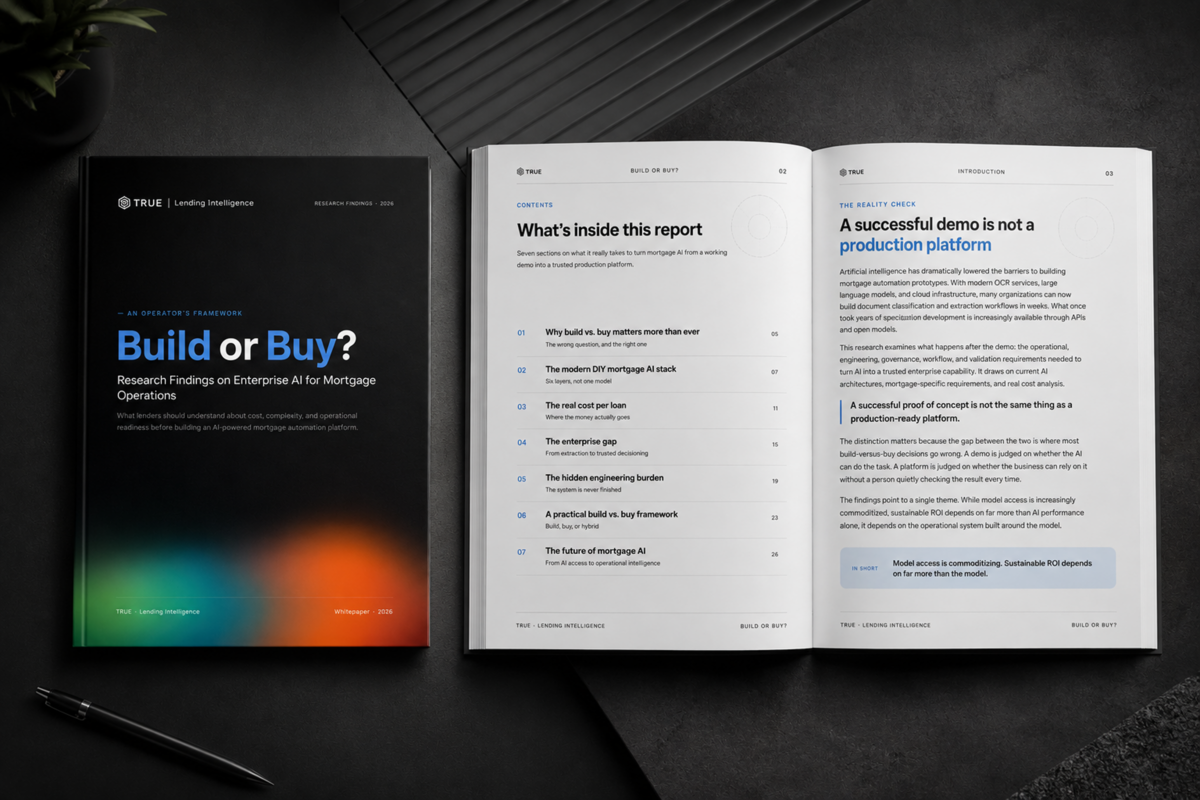
Our new eBook examines the build vs buy decision specifically through the lens of mortgage operations. Drawing on independent technical research, real-world mortgage workflows, and enterprise implementation experience, it breaks down the costs and responsibilities that are often missing from the initial business case.
For lenders already experimenting with AI, or preparing to make larger internal investments, this guide provides a framework for deciding what should be built internally, what may be better purchased, and where a hybrid approach makes more sense.
Inside the Guide
- What mortgage AI actually costs — including the infrastructure, engineering and ongoing operating expenses that can get left out of initial ROI calculations
- The engineering burden after launch — why production AI requires ongoing monitoring, maintenance, integration and specialized resources
- Why data changes the equation — and why reliable, mortgage-specific data infrastructure matters as much as the model itself
- The governance question — what lenders take responsibility for whether they build the technology or buy it
- Build vs. buy vs. hybrid — where each approach makes sense and the tradeoffs leadership teams should evaluate
- An executive decision framework — practical questions for technology, operations, risk and finance leaders to work through before committing resources
AI is moving too quickly to make a multi-year technology decision based on the cost of getting to version one. You might have the team to build it, but can you deploy it, integrate it, govern it, maintain it, and prove ROI at enterprise scale?

We might be able to help answer those questions.
What Else Should You Be Asking About Build vs. Buy
- Is building mortgage AI really cheaper than buying an enterprise platform?
- Not necessarily. The visible costs of a DIY approach are only part of the investment. Production AI also requires engineering, integration, testing, monitoring, security, governance, exception management and ongoing maintenance. If you need more explanation, our ebook looks at the total cost of ownership, including the costs that often don’t appear in the initial build estimate.
- If today’s AI models are so capable, why not just build internally?
- Modern LLMs have dramatically lowered the barrier to creating a proof of concept. But a tech demo is not the same as a working system. The harder work is building the infrastructure around the model like document processing, validation, workflow orchestration, auditability, exception handling, and integrations, all while maintaining all of it as models, documents and requirements change. The model may be easier to build around. The enterprise system is not.
- How should lenders think about build vs. buy if they already have a strong engineering team?
- Is building and continuously operating mortgage AI is the best use of those resources? Our eBook provides a decision framework for evaluating where proprietary development creates real competitive differentiation and where an enterprise platform may provide a faster, lower-risk path to production.
- What costs are most often overlooked when lenders decide to build?
- Ongoing engineering is one of the biggest. Production systems require continuous prompt and model evaluation, document taxonomy management, exception workflows, integrations, monitoring, security, compliance and user support. The system is never finished. The initial development budget tells you what it costs to launch. It doesn’t necessarily tell you what it costs to own.
- Is this really a build or buy decision?
- Increasingly, no. Most sophisticated lenders will likely do both. The more useful question is what should you build, what should you buy, and how should the two work together? Capabilities that create proprietary competitive advantage may justify internal development. Mature infrastructure that every lender needs may make more sense to consume through an enterprise platform. Our ebook explores the tradeoffs of DIY, enterprise and hybrid approaches.
- How should we measure whether our AI investment is actually working?
- Accuracy alone won’t tell you whether AI is removing work. A system can achieve high accuracy and still require employees to verify nearly every output. That’s why our ebook looks at Manual Review Rate (MRR) alongside accuracy. It looks at how much human work can safely be removed from the process. That ultimately has a greater impact on cost per loan, throughput and ROI.
- What changes when AI moves from a pilot into production?
- Almost everything around the model becomes more important. Production introduces uptime expectations, security, monitoring, auditability, governance, change management, integration dependencies and real users making real decisions from the output. That’s the gap our ebook touches on: getting AI to work is one challenge; getting an enterprise to depend on it is another.
- What’s the biggest question leadership should answer before deciding to build?
- Are you evaluating the cost of building the technology or the responsibility of owning it? Building means taking responsibility for the system beyond launch: its performance, infrastructure, security, governance, integrations, maintenance and continuous improvement. Our ebook gives technology, operations and executive teams a framework for deciding when taking on that responsibility creates strategic value, and when it doesn’t.