

Most mortgage lenders have experimented with Artificial Intelligence (AI). Some have launched small-scale pilots, testing the process within an isolated setting to observe the results. Other organizations have hit the ground running, implementing individual AI point solutions for one specific task, replacing manual processes with automation. However, far fewer institutions have leveraged AI to drive sweeping change throughout their organization’s workflow.
This gap showcases the biggest challenge facing mortgage lenders. How can institutions move beyond using AI in small, scattered ways to achieve full-process transformation?
A few years ago, the debate over AI was whether this new technology could deliver tangible benefits to the mortgage industry.
Today, the million-dollar question is what lenders must do to turn AI’s potential value into a trusted, measurable, repeatable capability that can be used across an enterprise lending organization.
The answer lies in looking beyond the technology itself.
Enterprise AI isn’t only a tech project. Technology is only one part of the equation. Leadership, governance, trusted data, workforce planning, change management, and strategic partnerships determine whether AI succeeds or stalls. Leaders must rethink workflows and define how people and technology will work together. Organizations must establish trusted data benchmarks and select the partners and infrastructures that align with them. Most importantly, the entire organization must align around change.
As Hemanth Jambulingam, Director of Product Management at Tavant, explains, “In three years, the AI leaders in mortgage will not be differentiated by who has the most AI tools, but by who has successfully redesigned their operating model around AI.”
The shift from deploying AI to operating differently because of it is what separates a stalled pilot from a scalable enterprise capability.
Rather than focusing on technology alone, this playbook explores the organizational, operational, and leadership decisions required to move AI from isolated use cases into production at scale.
“The real AI value is going to come from new workflows. It’s not going to be by optimizing one person’s day. It’s going to be a new, entire workflow that is a mission-critical part of the mortgage manufacturing process.”
— Steve Butler, CEO, TRUE
Key Takeaways:
- Organizations that start with workforce planning are better positioned to achieve adoption than those that start with technology selection.
- Technology initiatives gain momentum when every stakeholder understands the business objective — not just the technology.
- The quality of enterprise AI is determined long before underwriting or decisioning begins.
- The best AI partner is not necessarily the one with the newest model; it is the one best equipped to help lenders operationalize AI over time.
- Organizations should focus internal resources on mortgage expertise, not maintaining AI infrastructure.
- Technology changes workflows. Leadership changes organizations.
Introduction: Moving Beyond the Pilot
“The average lender thinks AI is probably far more competent than it actually is, and that they’re behind.”
— Ed Job, SVP, Mortgage Operations, TRUE
Since the rise of Artificial Intelligence, lenders have been caught between overestimating what AI can do immediately and underestimating its long-term impact. At first glance, AI can appear more advanced than it really is.
AI’s out-of-the-box capabilities are already impressive. It can extract and classify information, surface data in seconds, automate routine tasks, and assist employees. As a result, executives feel pressure to capitalize on the potential benefits, pushing them to act quickly — but more often than not, speed gets in the way of long-term planning.
A successful pilot isn’t the same thing as successful enterprise transformation.
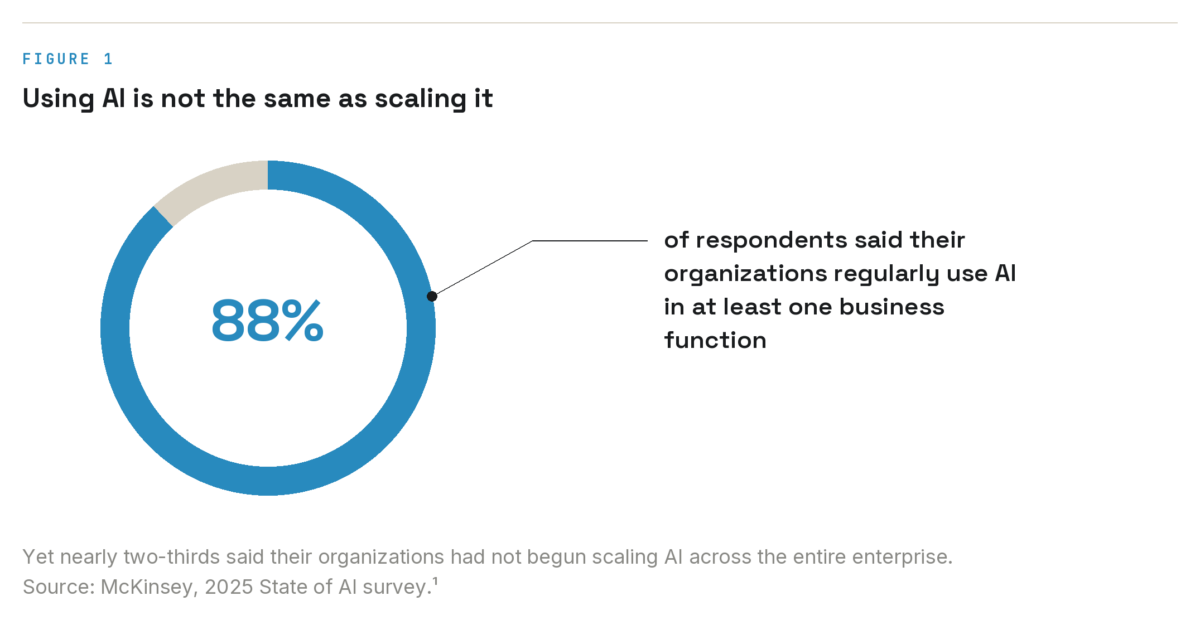
The mortgage industry isn’t the only one facing this challenge. According to McKinsey’s 2025 State of AI survey, 88% of respondents said their organizations regularly use AI in at least one business function. Yet nearly two-thirds said their organizations had not begun scaling AI across the entire enterprise. In the survey, organizations that redesigned workflows had the highest success rates.
Pilots work in a vacuum, but enterprise deployment brings real-world data, exceptions, legacy systems, regulatory considerations, competing departmental priorities, and every last employee into the mix.
“Sometimes, the success of the pilot becomes the obstacle,” says Matt Conrad, SVP, Technical Account Management, at TRUE. As implementations expand, the challenge quickly moves beyond whether the technology works to whether the organization can align around it.
The solution? AI doesn’t need more pilots. It needs a repeatable framework for moving AI into production.
Ultimately, AI shouldn’t be the starting point. Dr. Caleb Ondrusek, EVP Technology and Innovation, at Fairway Independent Mortgage Corporation says organizations should start with a clearly defined business problem, then determine which technology can solve it — and whether the solution needs to be AI at all.
“AI is a tool in the toolbox. It’s not the magical dust that’s going to fix everything,” Ondrusek says. In some cases, he notes, a rule engine or traditional OCR solution may still be more appropriate.
That distinction changes the executive conversation from “Where should we use AI?” to a more pressing question, “How should work operate differently because of AI?”
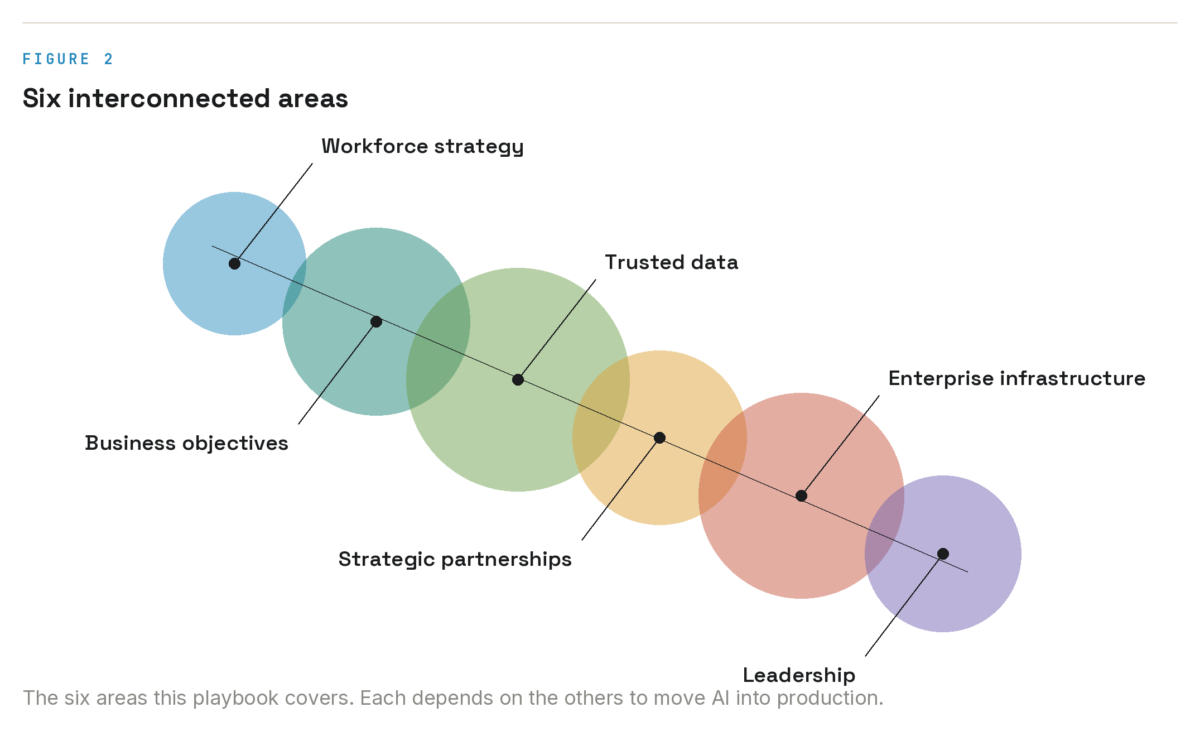
Answering it requires lenders to address six interconnected areas:
- Workforce strategy
- Business objectives
- Trusted data
- Strategic partnerships
- Enterprise infrastructure
- Leadership
Together, these principles provide a framework for moving AI out of experimentation and into the real playing field — production.
Principle I: Start with a Workforce Strategy, Not an AI Strategy
“There’s a very live and practical fear that AI is going to take my job, whether factually or hypothetically. Leaders need to be having those conversations and addressing that.”
— Brooke Anderson-Tompkins, Founder and CEO, Bridge AIvisory
Rather than zooming into the technology and letting everything else fade into the background, put your workforce first.
Before selecting a technology, lenders should first ask themselves a few key questions:
- What type of organization are we trying to build?
- Which activities should be automated, and where does human expertise create the most value?
- How should team members’ roles evolve as technology takes on more work?
These questions are especially important in the mortgage industry, where changing market conditions have historically created dramatic fluctuations in staffing needs.
At Fairway, Ondrusek says the goal is to use technology to help employees do more with less, while giving the organization greater flexibility as mortgage volume rises and falls. Rather than expanding and reducing the workforce with every cycle, technology could absorb some of that fluctuation.
“Leadership’s communication and having a workforce plan is the key to success,” Ondrusek says. “AI transformation is not going to happen without some type of workforce plan.”
That plan also needs to address the elephant in the room. Employee uncertainty is one of the most immediate barriers to successful adoption. For workers, AI implementation isn’t an abstract technology initiative. They want to know what it means for them and their jobs.
When those questions go unanswered, resistance can appear in small but notable ways. Ondrusek describes both overt and “silent change resistance.” Employees skip meetings or training, delay testing, focus on isolated errors, and avoid implementing it in their branches. Some put only a small percentage of eligible loans through the new AI-driven system.
As a result, successful workforce planning requires transparency about what AI is, and isn’t, intended to do. It also requires organizations to reconsider where human expertise adds the most value.
Underwriting is just one example. Ryan Edmonds, CEO at Candor says AI is changing the role of underwriters by removing manual review and other tedious tasks so they can focus their energy where they truly shine: critical thinking, judgment calls, and exception handling.
“Our AI is not replacing underwriters; we’re supercharging them,” says Edmonds. “Underwriters can do, in many cases, 3-4x the number of loan files than they were previously.”
Beyond underwriting, mortgage organizations also possess enormous amounts of institutional knowledge. To Michael Kelleher of Adopt the Brand, lenders’ “tribal knowledge” and subject matter experts are some of their biggest assets. AI creates an opportunity to make that knowledge more accessible, while reskilling and upskilling can help employees operate effectively within new workflows.
At Fairway, lenders also see automation as one way to make mortgage expertise more accessible to a new generation of workers. Instead of requiring employees to learn where every field, guideline, and piece of information lies, technology can surface relevant information within the workflow.
As Deedra Massey Bosworth, SVP of Technical Product Management at Fairway, puts it, “It’s almost taking that industry knowledge that’s there with the older workforce and putting it into the technology itself.”
Brooke Anderson-Tompkins, Founder and CEO at Bridge AIvisory, emphasizes the importance of a workforce-first AI deployment strategy, stating, “If there’s a greater fear around a use case and adoption falters, how can I address that at the front end instead of being disappointed with the ultimate outcome?”
All in all, the workforce question isn’t “How many people can AI replace?” It’s “What work should people be doing when technology can handle more than the rest?”
Organizations that answer that question before selecting and deploying technology are ultimately better positioned to build employee trust, preserve institutional knowledge, and create sustainable operational capacity.
| Put It Into Practice: Treat workforce planning as a prerequisite to AI transformation. The goal is to create an operating model that can absorb changing volumes, elevate human expertise, and evolve as automation takes on more work. |
Principle II: Define the Business Problem and Communicate It Clearly
“They’re basically starting with, ‘what can you do?’ What they really need to say is, ‘These are my business challenges. Show me how you can resolve these.”
— Matt Conrad, SVP of Technical Account Management, TRUE
After leadership understands the workforce they’re trying to build, the next step is defining the business problem AI is expected to solve — and communicate it clearly.
Rather than starting with a specific operational challenge and finding the technology to solve it, lenders often start with a technology and ask what it can do for them. The concern is that not every business problem requires an AI solution, and not every AI opportunity deserves enterprise investment.
Ondrusek has first-hand experience with this problem, saying, “I think really a lot of AI initiatives are failing because they’re not coming at it from a clearly defined business problem.”
After defining the problem, lenders can then determine whether an AI solution is actually appropriate. From there, leaders need a baseline to set clear expectations.
- What does the process cost today?
- How long does it take?
- How much manual review does it require?
- Where do exceptions occur?
- How many people work with it directly?
- And most importantly, what outcome would represent meaningful improvement?
Without these answers, an organization may be able to show that employees are using a new system — but it may not be able to prove the system is improving the business.
“It’s very common during implementation for the business to want to measure activity instead of measuring the outcome,” Conrad says. “Those are very different things.”
So, what do meaningful measures for AI success look like for mortgage lenders? A few examples include:
- Cost per loan
- Cycle time
- Automation rate
- Manual review rate
- Defect reduction
- Employee productivity
In some cases, it’s another outcome directly tied to the specific business problem.
Once leaders have identified the business problem they want to solve, whether an AI solution is appropriate, and the meaningful measure for success, the next step is to communicate the objective to the workforce.
Transparent communication for the people affected by the change carries on the workforce strategy defined in Principle I.
By clearly defining the business problem, bringing business teams into the process early on, and making discovery more inclusive, leaders can communicate the “why” and “how” to mitigate change resistance from teams.
Ultimately, the workforce shouldn’t simply receive a finished AI solution from the technology team. Underwriters, processors, loan officers, post-closing teams, and everyone in between can participate in the discovery process. In doing so, they help identify how their workflows actually operate based on firsthand experience.
Fairway’s Bosworth echoes the importance of early employee involvement. “I think building trust starts with getting feedback, right? Letting people use the system, getting feedback” notes Bosworth. “If they buy into something, then they’re much more inclined to adopt it.”
The most effective AI initiatives begin with the problem, not the model. Identify a high-value process, understand how it operates today, and establish a measurable baseline. Always bring the business into the process and define success so everyone understands what they’re working toward. Once the organization demonstrates that the new workflow creates value, expand.
| Put It Into Practice: Make the business case specific enough to measure before AI implementation even starts. With a clearly defined problem in place, lenders can evaluate whether AI is the right solution, establish accountability, and determine when an initiative is ready to scale. |
Principle III: Build a Trusted Data Foundation
“The first challenge is that data is fragmented across a large array of systems. The first thing lenders have to understand is: Where is the data I need, and how do I bring it into my environment?”
— Robert Brooks, CTO, TRUE
AI has the power to process massive amounts of data, but that doesn’t mean the information is always reliable. “AI generates data, but that doesn’t mean it’s trusted data,” notes Butler. As a lender, this distinction can’t be ignored.
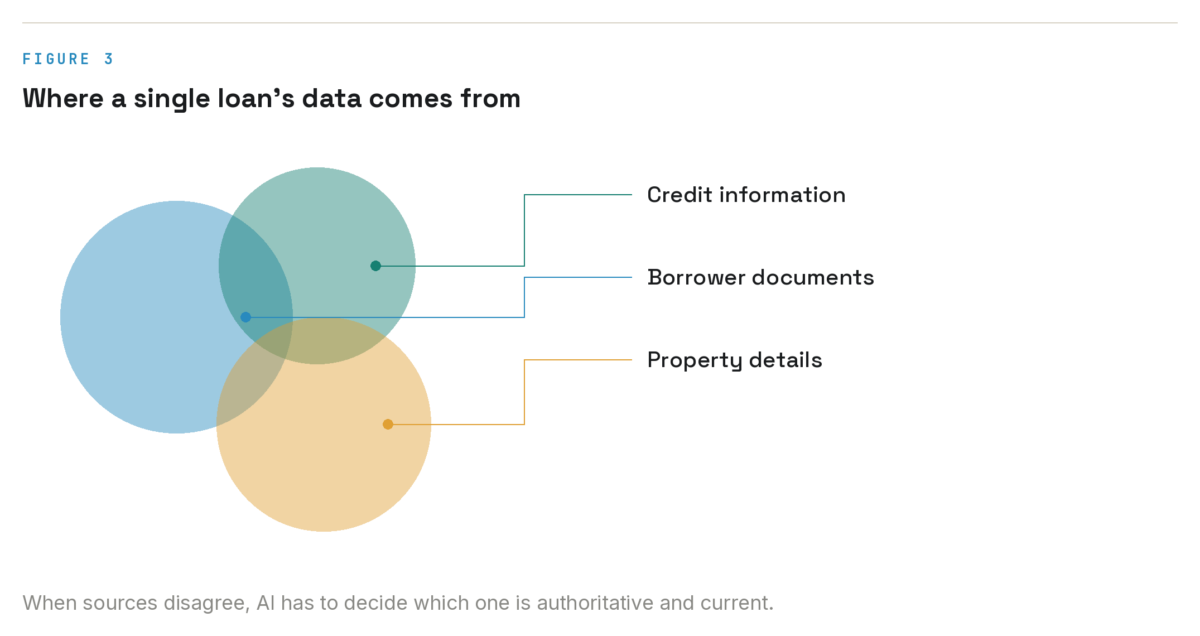
From the borrower’s documents to their credit information and property details, a single loan includes a wide range of data. If those sources are incomplete, inconsistent, or difficult to reconcile, that problem goes straight to AI. Ultimately, AI can’t compensate for these issues.
For Jambulingam, fragmented data is one of the most significant challenges lenders face when integrating AI. When information is spread across systems, AI must determine which source is authoritative, current, and ready to base decisions on.
As a result, data lineage is equally important. If AI supports an outcome, lenders need to be able to trace how the technology came to that conclusion.
Trust becomes even more pivotal when leveraging AI in high-stakes tasks. In terms of underwriting, Edmonds notes that “the cost of being wrong in underwriting is very high.” Errors at this step have significant consequences compared to low-risk situations, such as asking a borrower to submit a document.
For higher-risk applications, lenders must look beyond the headline accuracy score. A system that’s 95% accurate may sound impressive, but if employees can’t find the remaining 5% that needs confirming, they have to review the entire thing. In these cases, AI isn’t eliminating as much manual work as it could be if the team only had to review 5%.
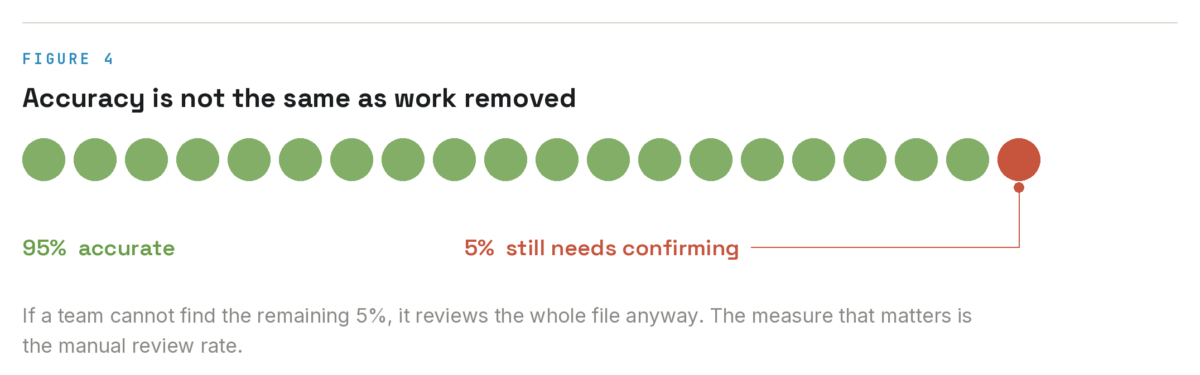
“AI is only as valuable as how much work can be eliminated from a user,” says Butler. “You can’t eliminate work unless you reduce the manual review rate.”
Trusted data allows the system to identify what’s been validated and what requires human review. Edmonds breaks it down in an underwriting context, noting, “Here’s what the technology couldn’t solve. These are the remaining exceptions. Here’s what you need to look at.”
The objective isn’t merely more data. It’s trusted, consistent, explainable, traceable data that can safely move through an automated workflow.
Every decision depends on getting things right from the beginning. Whether it’s document intake, classification, extraction, or validation, if the information is unreliable from the start, even the best models can’t compensate for the weakness down the line.
Remember, enterprise AI is only as strong as the data it has to work with.
| Put It Into Practice: Trust should be designed around the AI environment, not evaluated after deployment. By establishing clear lineage, validation, and exception thresholds, lenders can move more work through AI automation — without sacrificing oversight. |
Principle IV: Select a Trusted AI Partner
Don’t underestimate the importance of choosing the right vendor for your organization. With AI, lenders aren’t just buying new software. They’re selecting a partner whose technology will play a role in mission-critical workflows. In the mortgage industry, this includes processing sensitive borrower information, influencing operational decisions, and interacting with systems across the enterprise.
“Whether a vendor charges $25 or $30 per loan versus $10 is going to get washed out in the end. This is about focusing on the substance of a vendor and what they can deliver.”
— Steve Butler, CEO, TRUE
While taking the due diligence process for traditional tech vendors is important, AI adds additional questions to the list. Here are a few important starting points:
- Does the provider understand mortgage lending as deeply as it understands technology?
- Can it explain how outputs are generated?
- What validation controls are in place?
- How are models governed and monitored?
- Can the lender trace data and decisions?
- How does the provider address security, privacy, permissions, and regulatory requirements?
These concerns remain top of mind for compliance with the mortgage industry’s governance framework. In April 2026, Fannie Mae issued an AI/ML governance framework for Seller/Servicers using the technology in applicable origination and servicing activities. The framework requires policies and procedures addressing the development, implementation, use, maintenance, and risk management of AI/ML systems. It also requires Sellers/Servicers to manage the risks and governance of subcontractor and vendor AI/ML use in a way that is no less protective than the internal requirements.
In other words, AI governance doesn’t stop at the lender — it extends directly to the technology partner. Pay close attention when evaluating a provider’s governance, controls, and risk-management practices.
Beyond legal concerns, lenders also want technology partners that can grow with them. Brooke Anderson-Tompkins comments on lenders considering long-term viability, noting that “One lender told me they now ask for the financials of the vendor because the funding picture has an impact on longevity in your use case.”
Another important consideration is whether or not a vendor has a clear handle on where your organization is now. A strong partner should understand the lender’s current process before prescribing a future one. That includes identifying data requirements, exceptions, existing systems, users, controls, and measurable business outcomes.
From there, the technology’s architecture should encourage flexibility. Jambulingam argues that the strongest lenders will remain model- and vendor-flexible, allowing them to adopt better AI capabilities without rebuilding the underlying business process.
Remember, the newest model or lowest price doesn’t equal the strongest enterprise partner.
What lenders really need to know is whether a technology provider can help build a workflow that’s secure, trusted, explainable, and scalable. And most importantly, that it continues to perform — even as the technology and business evolve.
| Put It Into Practice: Keep a forward-thinking approach when evaluating AI partners. Consider the role they may play in enterprise, not just the use case they can solve today. Long-term value depends on whether a provider can support evolving governance requirements, integrations, scale, and the lender’s broader technology strategy. |
Principle V: Consume AI Through an Enterprise SaaS Platform
“Integrations therefore move AI from ‘answering questions’ to participating in business processes.”
— Hemanth Jambulingam, Director of Product Management, Tavant
Once you have access to a model, enterprise AI requires an operating system that connects the entire workflow. That’s where Software as a Service (SaaS) platforms come in.
“When we talk about infrastructure for enterprise AI in mortgage lending, I think it’s important to broaden the definition of infrastructure,” says Jambulingam. It’s “not simply cloud capacity, GPUs, APIs, or access to a large language model.”
To successfully scale AI, the infrastructure must be “an enterprise operating foundation that connects trusted data, systems, intelligence, workflows, controls, people, and partners,” according to Jambulingam.
Because a loan touches so many departments, teams, and third parties, “the operational complexity appears in the spaces between them,” Jambulingam notes.
Connected platforms can reduce the friction between steps by transforming a collection of systems into a coordinated lending system. With a well-oiled, synergistic machine in place, AI can operate as an intelligent layer across the workflow by:
- Understanding the loan.
- Identifying what has changed.
- Determining what requires attention and manual review.
- Executing the appropriate next step.
Ultimately, integrations allow AI to deliver its full operational value—moving beyond consuming information to participating in the dynamic workflow. Jambulingam states that proper integration allows AI, within defined controls, to validate data, update systems, initiate verifications, generate or clear conditions, trigger workflows, and escalate exceptions.
Rather than an employee stepping in for manual review, event-driven architecture lets an AI network react when something happens and decide what happens next.
At the same time, the architecture should have a plan in place for when automation can’t complete the work. “Exception management should be a foundational principle of the overall solution,” says Brooks.
When an AI can’t resolve a problem, it should be able to route the cases appropriately, retain traceability around human intervention, and create feedback loops that promote improvements.
“Anybody can drop an LLM into a solution and put up a bunch of pretty user interfaces,” says Brooks. “What distinguishes that from enterprise is the architecture, resiliency, precautions, traceability, lineage, and processing around it.”
A successful pilot proves that AI can perform a task. However, strong enterprise infrastructure lets that capability perform reliably at scale within the larger operating environment.
| Put It Into Practice: Scaling AI requires an operating foundation that extends beyond any one model or use case. The right architecture gives lenders the flexibility to add new capabilities over time without creating another level of disconnected technology. |
Principle VI: Lead Change From the Top
Workforce strategy is important. Business cases are a must. Strong data, the right partner, and a cohesive infrastructure all play a role in enterprise AI. But at the core of it all is a leadership challenge. If employees don’t adopt a new way of working, the roll-out is likely to fall short.
For mortgage lenders, leadership involvement is also becoming embedded in AI governance guardrails. Freddie Mac’s AI/ML requirements require applicable Seller/Servicers’ AI/ML policies and procedures to be approved by senior management, communicated to appropriate personnel working in those areas, assigned to an owner, and reviewed at least once annually.
“It’s not one person who needs to understand AI. A lot of people need to understand it—and understand it in relationship to the whole organization and what they are attempting to accomplish.”
— Brooke Anderson-Tompkins, Founder and CEO, Bridge AIvisory
Outside of the mortgage space, McKinsey research also found that CEO oversight of AI governance is among the factors most correlated with higher self-reported bottom-line impact from generative AI. The research also identified practices tied to successful AI adoption and scaling as:
- Senior-leader engagement
- Regular internal communication
- Role-based training
- Defined KPIs
- Employee trust
- Feedback mechanisms
- Clear adoption roadmaps
“I think we underestimated the amount of change resistance that we were going to get,” says Ondrusek of Fairway’s experience with AI implementation. “I’ve been in IT for 20 years. I have never met more challenging implementations than AI initiatives because folks are so scared of losing their job as it relates to AI.”
With AI commonly being discussed in the context of job displacement, employees often approach new automation tools with legitimate concerns over what it all means for their role.
As the bookend to Principle I, leaders need to answer those questions directly. Explain why the organization is implementing AI, what the technology can and can’t do, how workflows will change, and where employees fit into the future operating model. This message shouldn’t come once with the initial announcement and then go silent. Leaders must consistently reinforce these answers, remain visible, and create an open line of communication around the topic.
At Fairway, Bosworth describes executive visibility as critical to implementation. Employees repeatedly hearing the same message from the executive team reinforces that AI and automation aren’t just temporary initiatives. At the same time, executive teams must be aligned around the rollout plan, process, and communication.
One way that Fairway has been able to build trust from the bottom up is by having actual users volunteer for pilot groups. By having them provide feedback and share their experiences with their team members, it eliminates some of the hesitation and friction from the situation.
“It’s more about the people that are actually using it and what they’ve gained from it, the efficiencies and the benefits and communicating that to the rest of the employees rather than us doing it on a corporate level or an executive level,” Bosworth says.
When it comes to training, go beyond a simple how-to with the system. “Training is a big thing, and that’s not training on the system. It’s training focused on operational change,” Conrad says.
Leaders should also pay attention to adoption rates. If employees aren’t actually using a system, it’s an early indication that the technology isn’t working. Even if deployment seems successful, organizations aren’t going to get the intended return if employees aren’t using it.
As Anderson-Tompkins puts it, “One of the ultimate outcomes is adoption, and adoption is connected to ROI.”
All things considered, technology adoption succeeds when leadership consistently reinforces the vision, communicates progress, and creates organizational trust.
Technology can change a workflow. But leadership determines whether the organization changes with it.
| Put It Into Practice: Leadership’s responsibility doesn’t end when AI is approved or deployed. Make sure employees are aligned as workflows evolve, keep an eye out for resistance, and make sure organizational change is at the forefront of the long-term AI strategy. |
From AI Implementation to Operating-Model Transformation
The mortgage industry doesn’t need a new wave of disconnected AI experiments. What moves AI from pilot to production, from an isolated technology initiative to an enterprise capability, is leadership with a strong plan grounded in the six principles.
The next stage of AI maturity in the mortgage industry won’t be defined by how many tools lenders deploy. As AI capabilities become more accessible, the advantage comes from what lenders build around the technology.
To do that, organizations must:
- Start with a workforce strategy.
- Solve clearly defined business problems.
- Build on trusted data.
- Choose the right technology partners.
- Leverage enterprise infrastructure.
- Lead employees through the change.
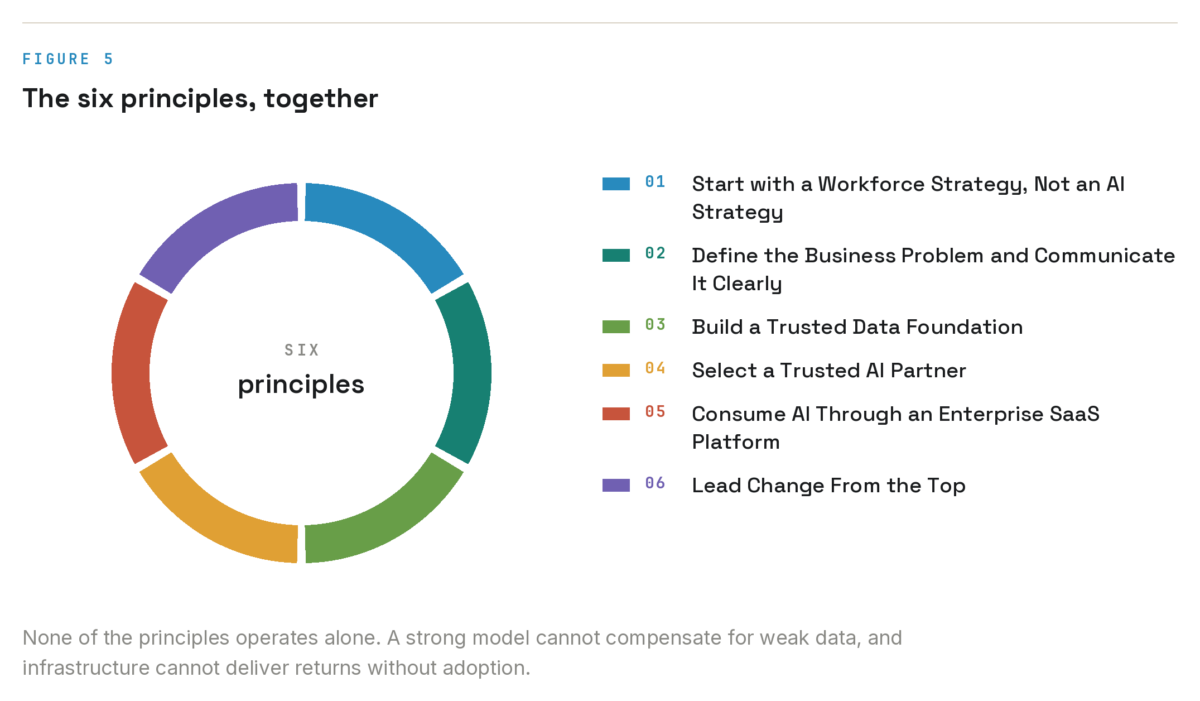
None of the principles we’ve outlined in this playbook operates alone. A strong AI model can’t compensate for weak, unreliable data. If the technology is isolated from the larger workflow, trusted data brings limited value. Even the best infrastructure can’t deliver meaningful ROI if employees don’t adopt it.
Moving from pilot to production requires lenders to think beyond AI implementation and toward operating-model transformation. According to Jambulingam, the leaders of the future won’t be differentiated by who has the most AI tools. Those who stand out will have successfully redesigned their operating model around AI.
For mortgage lenders, that’s the opportunity ahead. It’s not about automating the work employees already do. It’s about rethinking workflows from the ground up — and building a more trusted, scalable, and efficient mortgage operation around it.
Click to download full PDF version
Contributing experts
Industry leaders interviewed for this playbook and referenced throughout. Our thanks to each of them for their time and candour.
Brooke Anderson-Tompkins, Founder & CEO at Bridge Alvisory
Brooke Anderson-Tompkins spent over two decades in mortgage banking as a leader, a lender, and an entrepreneur. She started as a loan processor, was offered the opportunity to purchase the company, and spent the next twenty years building it, merging it with New York’s largest independent real estate mortgage affiliate, where she served as president until 2023. She founded Bridge Alvisory to help organizations move from uncertainty to clarity in the Al age, and previously chaired the Community Mortgage Lenders of America.
Ryan Edmonds, Chief Executive Officer at Candor Technology
Ryan Edmonds is the CEO of Candor Technology, where he leads the company’s mission to transform mortgage lending through intelligent automation and expert decisioning technology at scale. Prior to Candor, Ryan founded two startups and spent 15 years in investment banking at Houlihan Lokey. A patent holder, he aligns strategic growth and key partnerships with internal innovation to expand trusted and rapid Al decisioning into more segments of the mortgage market.
Hemanth Jambulingam, Director, Product Management and Partnership at Tavant
Hemanthkumar Jambulingam is Director Product Management and Partnership at Tavant, with over a decade of experience in mortgage banking, financial technology, and digital transformation. He focuses on applying Al, intelligent automation, and modern technology platforms to transform the mortgage lifecycle, helping lenders improve operational efficiency, decisioning, and the overall lending experience.
Michael Kelleher, Mortgage Subject Matter Expert and Connector at Adopt the Brand
Michael Kelleher has spent over a decade where mortgage meets technology. He built a white-label mobile platform used by 72,000 loan officers across 200 lenders, mobilizing more than $50 billion, and brought the term “lending ecosystem” to the Industry. His work now centers on the technologies lenders are handing to Al, from document classification to workflow automation. He hosts The MikedUp Show, sits on the board of the Massachusetts Mortgage Bankers Association, and serves on the MBA’s Presidential Technology Committee.
Deedra Massey Bosworth, SVP, Technical Product Management at Fairway Home Mortgage
Deedra Massey Bosworth is the Senior Vice President of Technical Product Management at Fairway Home Mortgage, bringing more than 20 years of mortgage industry experience and helping bridge the gap between innovation and practical implementation. With deep expertise in operations, leadership, and emerging technologies, she is passionate about leveraging artificial intelligence to drive efficiency, and is currently focused on advancing Al-enabled capabilities that elevate both customer and employee experiences.
Dr. Caleb Ondrusek, EVP, Technology and Innovation at Fairway Home Mortgage
Caleb Ondrusek is Executive Vice President of Technology and Innovation at Fairway Home Mortgage, where he helps shape the company’s strategy across artificial intelligence, automation, and emerging technologies. With nearly two decades in technology and more than eight years at Fairway, he leads teams focused on building practical solutions that simplify complexity, improve execution, and keep the human experience at the center. As a licensed mortgage loan originator, he brings a grounded understanding of the regulatory and lending environment.
Sources
McKinsey & Company, 2025 State of Al survey https://www.mckinsey.com/capabilities/quantumblack/our-insights/the-state-of-ai-2025
Fannie Mae, Al/ML governance framework for Seller/Servicers (April 2026) https://singlefamily.fanniemae.com/media/45196/display
Freddie Mac Single-Family Seller/Servicer Guide, Section 1302.8 https://guide.freddiemac.com/app/guide/section/1302.8
McKinsey & Company, The State of Al: How organizations are rewiring to capture value https://www.mckinsey.com/capabilities/quantumblack/our-insights/the-state-of-ai-how-organizations-are-rewiring-to-capture-value